12/22/2022
Broadway Las Vegas
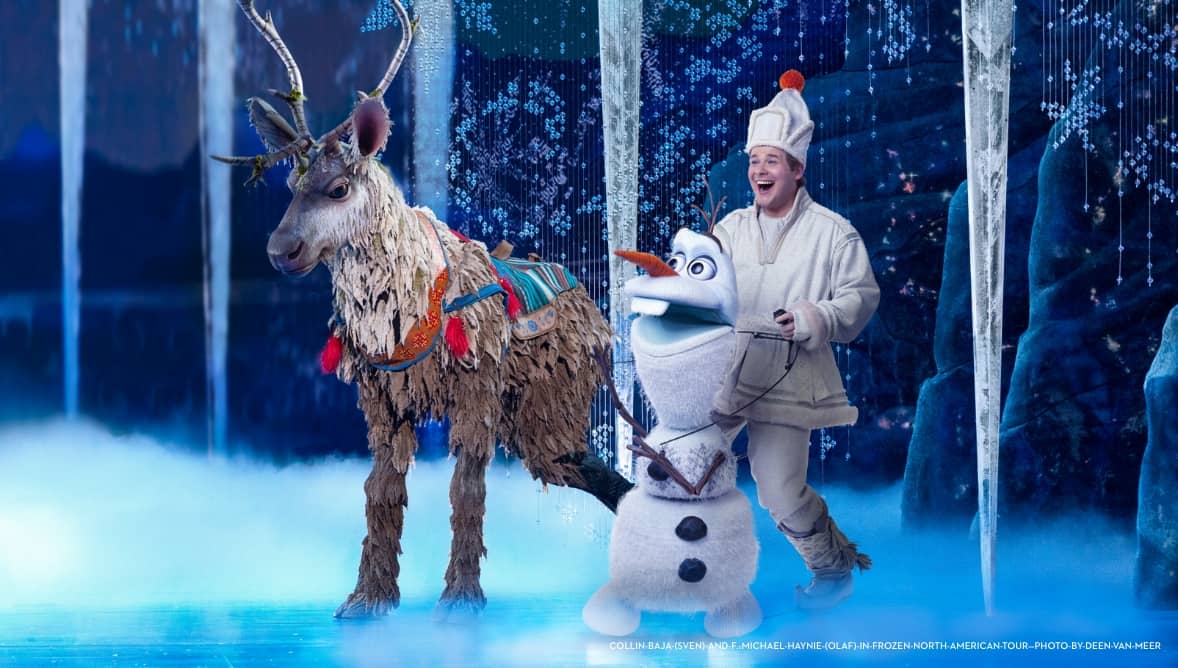
Did you know that Elsa’s ice dress contains more than 10,000 crystal beads? Or that the King and Queen wear large buckles, based off of actual Viking jewelry pieces from 900 AD? Enjoy these fun facts about the amazing costumes featured in Disney’s Frozen, coming to The Smith Center March 8-18.
-
Frozen’s costumes’ fabrics and trims are sourced from 17 countries:
-
USA
-
England
-
Scotland
-
Norway
-
Sweden
-
France
-
Italy
-
Austria
-
South Korea
-
Japan
-
India
-
Ukraine
-
Germany (Hygge hat felt)
-
Czechoslovakia (Swarovski)
-
Canada (epaulet embroidery)
-
Pakistan (King epaulet fringe)
-
Latvia (Kristoff mitts)
-
Wales (Anna mitts)
-
Elsa’s Ice dress takes one person 42 days to bead, with over 10,000 stones.
-
Sparkle count:
-
On Elsa’s ice dress:
-
Sew-on stones: 954
-
Crystal beads: 10,800
-
Lochrosen crystals: 3,600
-
Hotfix crystals: 2,880
-
-
-
-
On Elsa’s “Monster” costume
-
400 sew-on stones
-
1,100 crystal beads and Lochrosen
-
-
-
There’s no real fur in the show. The fur on Kristoff’s costume is custom knitted. The production uses nearly 30 different kinds of faux fur.
-
There are 154 costumes on stage during the course of the show. Swings and understudies have an additional 144 costumes.
-
Young Anna has the fastest quick change in the show at only 8 seconds, requiring the assistance of three people.
-
There are 48 different kinds of flowers and grasses and 71 different types of ribbons in the opening garlands.
-
There’s a repeated motif of a snowflake in a heart repeated in costumes throughout the show. In addition to being a traditional Scandinavian motif, it reveals some of Anna’s story. Can you spot them? (Spoiler: this motif appears in the gold pendant that Anna wears, as well as in her travel dress, among other places).
-
Every single item of clothing onstage is custom-made for the show, with the exception of socks, a few pairs of shoes, and the men’s gloves.
-
The Ensemble clothes are primarily based on bunad, the folk costumes of Norway. Each region of Norway has its own style and pattern variations of bunad, and the production incorporated many of them into the world of Arendelle.
-
Kristoff and Olaf’s costumes are based on the traditional clothing of the Sami, the indigenous people of Scandinavia. Kristoff is firmly rooted in this world, as the Sami culture revolves around reindeer herding.
-
The design process began with research and sourcing fabrics, all based around that idea that the costumes needed to function primarily as real clothes. The palette of the show reflects this, using many authentic natural materials, such as wool and linen, in a rich natural palette.
-
Elsa’s clothes are designed to follow her character’s journey. She begins in stiff clothes, fully covered, and always with gloves. This reflects her fear of her own power and the way in which she closes herself off from everyone around her, including her sister. As she becomes more confident in her magic, she sheds these constricting garments and we see her in a dress made of ice that appears to be growing organically from her skin. The curling motifs of ice in this dress reflect her newfound joy. When the story takes a darker turn, Elsa’s ice motifs become sharper and jagged, while she gains independence and moves further from society’s expectations, even putting on pants!
-
The Arendelle crest is a crocus flower. We see this repeated on the set and in the costumes, even in details you may not see from the audience - it’s on Elsa’s shoes, the Guards belts, even on the King’s necklace.
-
The King and Queen wear large buckles, based off of Viking jewelry pieces from 900 AD.
-
The show incorporates many elements of hand crafting, which would have been common at the time, including hand beading, knitting, crochet, and needlepoint. The production uses the latest developments in theatrical technology, such as digital printing, carbon fiber 3D printing, and thermoplastics.