12/18/2024
Performances and Artists
-
A sacred deer dance
The opening number Koe features a traditional Japanese performing art called Shishi Odori, which means “deer dance.” Shishi Odori is upheld in the Tohoku region of Northern Honshu, where performers wearing deer masks and antlers dance with two long rods called “sasara” attached to their backs, slapping them on the ground to create whip-like sounds. To prepare for this performance, the Kodo members head into the forest on Sado Island to cut down bamboo, which they shape and adorn with strips of paper. Kodo learned this art form from locals who uphold it in Iwate Prefecture in the 1980s and arranged it for stage performances.
-
A “leg-day” piece featuring rhythms from an island in the Pacific
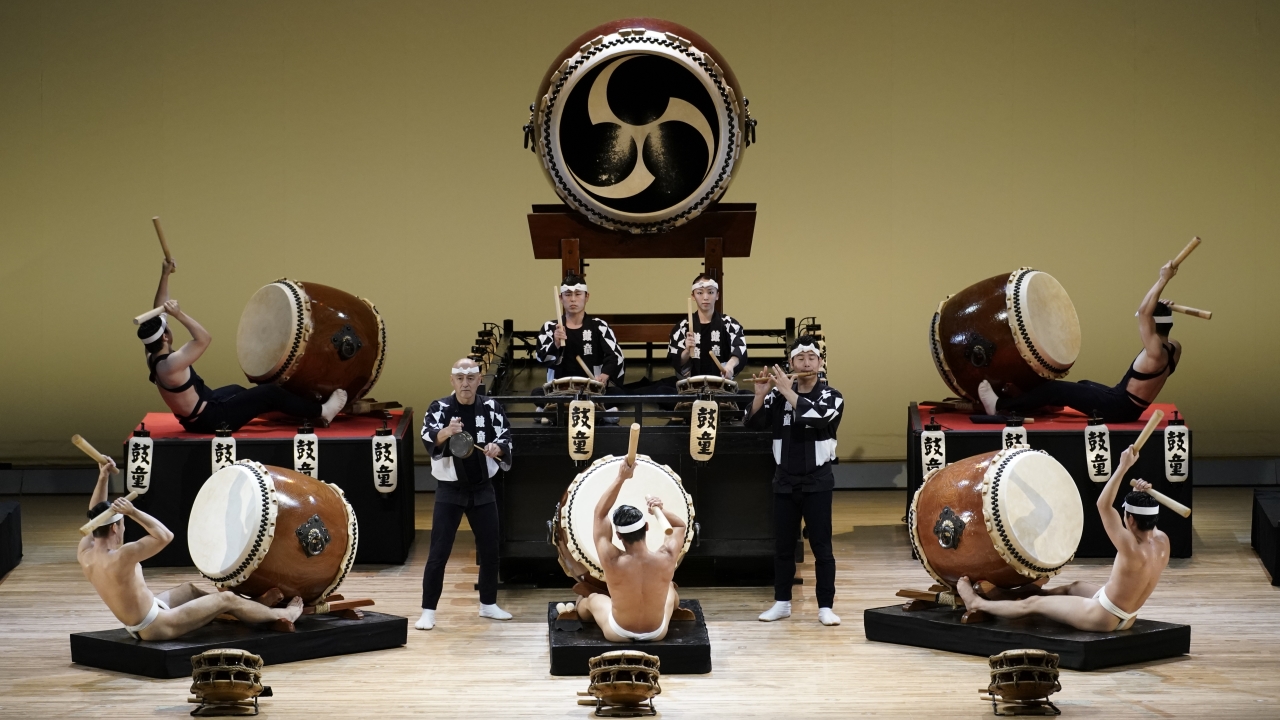
Miyake is a powerful piece where the drummers maintain a low squat stance to beat a horizontal drum from side on with immense power. This style of drumming originates from a regional festival on Miyake Island, located 180 km south of Tokyo in the Pacific Ocean. Kodo members learned this style of taiko on the island in the early 1980s and arranged it for the stage. It went on to become one of Kodo’s signature pieces and a crowd favorite that inspired people all over the world to play Miyake Taiko. Kodo performers practice this piece before joining the group as part of their training at Kodo Apprentice Centre, building up the stamina and lower body muscles required to play it. It’s leg day when you play Miyake. You’ll see why.
-
The way taiko can evoke a wide range of emotions
Upheld throughout Japan in various forms, Niwaka is a traditional folk performing art where people perform improvised skits filled with satire and wit. Kodo’s new piece Niwaka draws inspiration from that art form to create a banter-like performance between two men and two women, demonstrating a comical and nimble form of taiko expression. It’s a taiko piece and a theatrical interlude all rolled into one.
-
A jam session with Caribbean percussion
You’ll see more than just Japanese instruments on stage in a Kodo performance. In Hae, which means “southern wind,” Kodo performers play taiko and the Japanese harp along with steelpans. This piece features a three-beat rhythm and the unique melodic scale from Okinawa, the southernmost part of the Japanese archipelago. Hae was created after Kodo members traveled to Okinawa years ago to learn songs and dances. This piece brings the excitement of improv to the Kodo stage, something rather rare for the ensemble. It promises to conjure a unique summer breeze every time.
-
An accent of a different kind
Uminari is a big ensemble piece featuring the whole cast of Warabe. It’s a challenging number that includes faint rhythms between the regular notes—something you can’t fully capture in Western musical notation. Traditionally, Japanese folk music is handed down orally. Throughout Japan, people speak with distinct regional accents, so when they speak the taiko rhythms, their accent adds a unique regional flavor to the music. Uminari takes its inspiration from taiko played at Japanese festivals and uses those delicate accent-influenced rhythms to drive this dynamic piece.
-
An effort to preserve one of Sado Island’s disappearing folk arts
Onidaiko—a demon deity dance set to the beat of taiko—is the most famous performing art on Sado Island, where Kodo is based. It is performed in villages all over the island in spring and autumn as part of the planting and harvest festivals. Today there are about 120 distinct types of onidaiko, differing from village to village. In Warabe, the piece Okoshi features a style of onidaiko upheld in a village where it is no longer performed due to the declining population. Seeing the few remaining locals waiting for it to be forgotten, Kodo was moved to help it live on by capturing its essence within a performance piece.
-
A rare moment where a Kodo performer addresses the audience
On Sado Island, onidaiko is performed as a prayer for abundant crops and good health. Before the demon deity dance begins, one performer greets the audience and offers a prayer for the happiness of everyone gathered around for the festivities. By bringing this to the stage, Kodo hopes you’ll feel the excitement this oration conjures at local festivals on Sado, as people wait for the music and dancing to begin. May this greeting and performance bring you happiness and good health in the New Year!
-
The only taiko drum in the world that you can tune differently on either side
Dokuso means “solo performance.” This piece is played on an innovative drum called Kanade, which was co-developed by master taiko maker Asano Taiko and Kodo. It’s the only taiko in the world that lets a performer tune the drumhead on either side to a different tone, thanks to the metal fasteners that keep the ropes at distinct tensions on either side. Experience a unique taiko solo where the drummer shows the broad expressive range you can explore with two sticks, two tones and myriad rhythms.
-
A life-affirming piece originally created for a taiko and orchestra collaboration
The global pandemic derailed Kodo’s touring and forced the ensemble to spend months at its base on Sado Island. Unable to perform, the members of Kodo had a rare opportunity to reevaluate their activities and way of life. It was a time for studying, reflection and creation at Kodo Village. One of the fruits of that period was Inochi, meaning “life force,” an opus composed by one of Kodo’s members for taiko and orchestra with six movements. It premiered in 2021 at a commemorative concert with Tokyo Symphony Orchestra to mark Kodo’s 40th anniversary. In Warabe, the ensemble presents a Kodo-only version of this work.
-
An ab workout and drum solo all in one
Every winter in Chichibu, Saitama Prefecture, an all-night festival is held featuring richly decorated two-story yatai (carts) that large troupes of locals pull along the city streets. The people hauling the yatai are kept in time and urged on by the powerful beating of the taiko, concealed in the cramped first story of the carts. This gave rise to a technique of drumming while seated. If you’re in a cart, there’s a limit to how much you can move your torso and extend your arms, but on stage, there is plenty of space to give a full-throttle performance. You’ll see the performers getting a great ab and cardio workout as they drum, showing just how much exercise is possible when you’re sitting down.