7/5/2023
Discovering The Smith Center
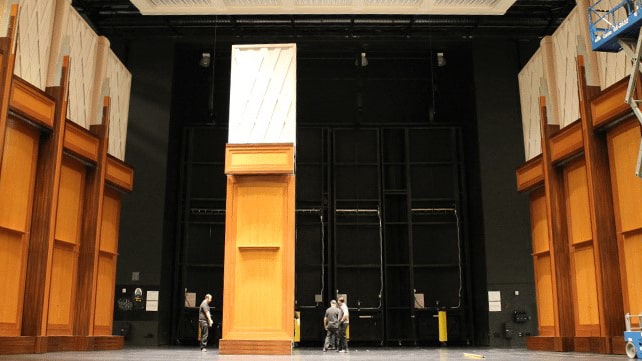
Audiences see magic happen with every show at The Smith Center.
This could be a girl gliding atop a flying horse in “The Nutcracker,” or a village turning to ice in “Frozen,” or the Las Vegas Philharmonic thundering a Beethoven symphony beside a 100,000-pound acoustic shell.
Little do audiences know who makes all of this magic possible: The Smith Center’s crew members, working backstage.
With specialties spanning carpentry, audio, lighting, sets and more, these highly skilled workers ensure every detail behind-the-scenes goes off without a hitch.
And they do so for all of the 400-plus shows and events The Smith Center presents each year.
“To do a show without crew is impossible,” says John Wrote, head audio engineer with The Smith Center since its opening. “Whatever somebody needs, we do, and we do to the best of our abilities.”
Countless Duties
Crew members always have much to do – especially with the load-in and load-out for each show.
This means unloading equipment, costumes, sets and props from touring shows’ vehicles, painstakingly organizing and assembling it all, then eventually dismantling and loading it all back up.
“I’ve learned that (a load-in) takes as long as you have, and sometimes you don’t have much time,” says Wrote, adding that load-ins can stretch from mere hours to multiple days.
The scale of load-ins can also vary dramatically, from Broadway musical “Frozen” — which rolled up with 24 semitrucks full of equipment and costumes — to family show “The Stinky Cheese Man and Other Fairly Stupid Tales,” which carted the entirety of its materials in four suitcases.
Greg Bober, associate head audio engineer, easily understands the needs of touring shows.
He worked for three years as production lead for the national “Hamilton” tour, where he determined how to install the show’s 70 speakers and sea of audio cables at a new venue every month.
“You could change where the speakers pointed without touching, doing it all with software, so part of my job was to go into a theater and draw a 3D map and tell the speakers how to cover the room,” he recalls.
The tour set itself apart with a heightened commitment to quality, he adds, even sending Bober to set up each upcoming venue days ahead, while the cast was still performing in another city.
He applies what he learned on the road to working at The Smith Center, he adds.
“I know exactly what people want to know when they come into the room,” he says. “How do we get from the loading docks to the stage? Where do we get our power from? A lot of it’s logistical.”
Lights, Audio and Special Effects
Crew members handle many additional duties, with highly different needs for each production.
“Every show has something that’s different,” Bober says.
Robert Brassard, head of lighting, oversees the installation and operation of each show’s elaborate lighting. Meanwhile, Head Carpenter Bobby Joyce manages the construction of weighty set pieces.
Beyond that, the crew must install audio equipment, secure mics on all performers, and decipher numerous issues like “how to put microphones in pants for tap numbers,” Wrote says.
They also move massive set pieces during performances, and even assist with special effects.
“There are lots of moving pieces and heavy stuff,” Bober says. “Once the show starts, there are plenty of safety things you’ve got to worry about.”
No Two Shows the Same
Smith Center crew members work almost every day of the year – not only for performances, but also for community events – and every day proves different from the last.
“I think the only thing I haven’t done here on this stage is a bris,” Wrote chuckles, adding that the center has hosted weddings, funerals, proposals, graduations and so much more.
And with performances spanning theater, music, dance, speaker series and more, crew members’ tasks can alternate from constructing arches for the choir in “Carmina Burana,” to moving the 9,000-pound house in “The Nutcracker,” to arranging a crash pad for acrobats in a Cirque du Soleil fundraiser.
Wrote says the most “basic” work they do is setting up the philharmonic’s acoustic shell, though this still requires four hours of “arduous manual labor.”
The crew doesn’t mind any of this work one bit.
“We all want the shows to be as great as they can be,” Wrote says.
The Challenges of Immense Broadway Shows
Broadway shows can pose the greatest challenges for crew members.
Many Broadway musicals require an army of workers to prepare for the stage, like “The Phantom of the Opera” that travels with 23 semitrucks of set pieces and costumes, and “The Lion King” with 18 trucks.
“It does get stressful, with ‘here’s my $200-million show, can you make sure it goes OK?’” Wrote laughs.
To add to this responsibility, many Broadway shows involve gargantuan set pieces and complicated props, which the crew must install and operate with utmost care.
This includes the chandelier in “The Phantom of the Opera,” which requires careful adjustments to the Reynolds Hall ceiling.
“There are special things we have to do to the building to accommodate a 1-ton chandelier crashing to the ground without killing anybody,” Wrote says.
Other challenges have included the elaborate set-up for the device that hoists Elphaba into the air for “Wicked,” and hanging the largest proscenium the crew ever installed for “Moulin Rouge.”
Ongoing leaps in technology also make Broadway shows more complex, Bober adds. For “Frozen,” crew members operated 52 inverted motors to move immense, heavy LED walls.
“There’s more and more technology (with shows). There are massive video walls, and lighting rigs and sound rigs keep getting bigger and bigger,” Bober says. “That takes quite a bit of work, to make sure it all works together.”
A Job to Enjoy
Regardless of deadlines and backstage complexities, crew members enjoy every day on the job.
They often see audiences’ elated reactions, which makes all the hard work worthwhile.
“It’s fun, and it should be,” Bober says. “If you’re working in the arts and not having fun, what’s the point?”