1/17/2024
Performances and Artists
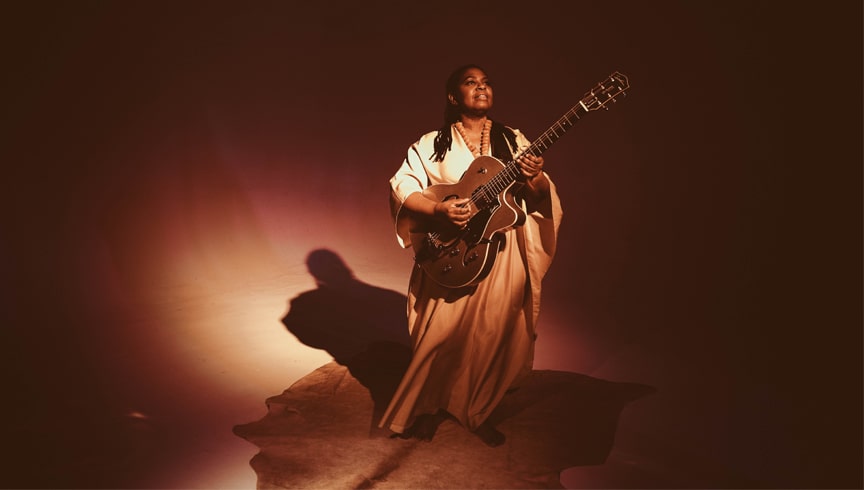
Sometimes when acclaimed vocalist Ruthie Foster wraps up a concert, the four-time Grammy nominee finds something thrilling waiting for her.
“Being a Black woman in this business, (I feel surprised when) I get to the merch table and I see a white, older male at my table and he’s in tears and says, ‘I never do this. I never buy CDs, but tonight you moved me,’” says Foster, who will perform live in Las Vegas February 22 and 23 at The Smith Center. “And that is what gets me out of bed (in the morning).”
Foster resolutely believes in music’s power to make divisions disappear, and she wields her passionate, fiery vocals to achieve just that.
Influenced by legends like Aretha Franklin, Foster crafts a distinctive sound that nods to soul, gospel, blues, jazz and beyond, her nine studio albums garnering a steadfast fanbase across numerous contries, ages and backgrounds.
Foster’s eclectic appeal especially rings true with her latest album, Healing Time, which she cowrote with her bandmates — all accomplished artists in their own right — quilting their specialties of rock, jazz, blues and more into uplifting earworms.
“That’s what makes this album different and makes it special and makes it stand out,” Foster tells The Smith Center. “(My bandmates and I) come from different places, but then end up on the same page.”
“I just want everyone to have a hallelujah time,” she says. “It’s about everyone lifting each other up. That’s what I hope my music says to people.”
Unearthing Musical Gems
To expose audiences to a joyful spectrum of music, Foster studies as many sounds as she can.
Touring the globe has introduced her to jazz experts who significantly informed her approach to blues and soul, she says. She also earned a United States Artists Fellowship to support her research of various song forms.
Foster performs lesser-known musical gems alongside more “conventional and commercial soul and gospel” at her concerts, she says. “I try to look at myself as a teacher when it comes to my performing.”
She particularly strives to showcase lesser-acknowledged voices of blues and jazz, and often performs tunes by female visionaries within these genres.
“Women were a huge influence in blues music, and not just for being the victims that the male is talking about — who he wants to get and who’s done him wrong,” she says. “We have such a huge story that hasn’t even begun to be told.”
An Album of Healing
Written during the pandemic, Foster’s latest album helped her cope with the loss of a band member and the stress of the lockdown.
“I think music was important to all of us (at that time),” she says, adding that the album allowed her and her bandmates to keep music alive when “we weren’t sure when we could get out again and do what we do in front of an audience.”
She hopes audiences will feel transported and elevated by these heartening melodies. “Something happens when you’re in the same room and people are feeling something in a particular song,” she says. “It’s about realizing that you’re part of the same race — the human race.”
SEE THE SHOW
Ruthie Foster performs at Myron’s at The Smith Center on Feb. 22 and 23 – for tickets, CLICK HERE.